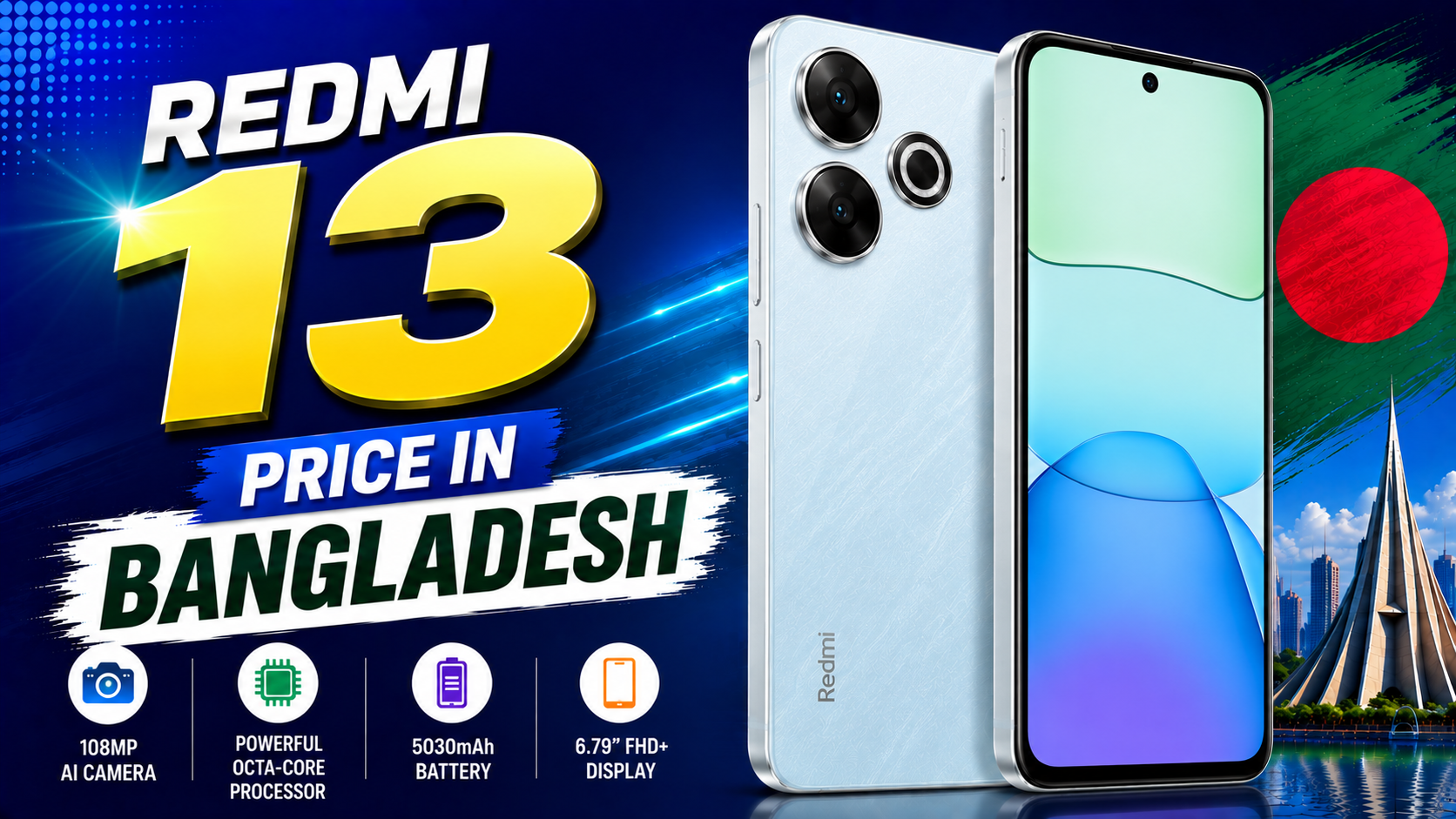
The Redmi 13 is a budget-friendly 4G smartphone from Xiaomi that focuses on delivering a large display, high-resolution camera, long battery life, and a modern software experience without moving into a higher price category. It was introduced in 2024 and is aimed primarily at users who want a dependable everyday smartphone for social media, entertainment, photography, communication, and moderate gaming. Xiaomi positioned the device as an affordable option with several features that are normally attractive to buyers in the entry-level and lower-mid-range segments.
One of the most noticeable aspects of the Redmi 13 is its 6.79-inch FHD+ display. The 90Hz refresh rate makes scrolling through websites, social media feeds, and menus feel smoother than a traditional 60Hz panel. The large screen also makes the phone suitable for watching YouTube videos, movies, browsing, and reading. The display resolution of 2400 × 1080 pixels provides reasonably sharp text and images for this class of device.
Photography is another major selling point. The Redmi 13 features a 108MP primary rear camera accompanied by a secondary 2MP sensor. The high megapixel count gives users plenty of resolution for daylight photography and allows for cropping into images while retaining useful detail. On the front, there is a 13MP selfie camera designed for video calls, selfies, and social media content.
Under the hood, Xiaomi uses the MediaTek Helio G91 Ultra chipset, paired with up to 8GB of RAM and up to 256GB of storage depending on the market and variant. The hardware is designed more for everyday use than demanding flagship-level gaming. It can handle common applications such as WhatsApp, Facebook, Instagram, YouTube, Chrome, and streaming services, while gaming performance is best described as suitable for casual and moderately demanding titles.
Battery life is another strong area. The Redmi 13 carries a 5,030mAh battery and supports 33W wired charging. This combination gives the phone the capacity to comfortably handle a full day for many users, while the larger battery is particularly useful for people who spend significant time watching videos, browsing social media, or using mobile data.
Redmi 13 Price in Bangladesh
The Redmi 13 price in Bangladesh depends on the RAM and storage configuration, seller, availability, and whether the phone is being sold through an official or unofficial channel. At launch in Bangladesh, Xiaomi announced pricing of BDT 17,999 for the 6GB RAM + 128GB storage version and BDT 19,999 for the 8GB RAM + 128GB version.
Market listings can change over time. The supplied MobileDokan listing currently shows a price of around BDT 16,999, although buyers should confirm the latest retailer price, warranty status, and exact configuration before purchasing.
For buyers searching for Redmi 13 price in Bangladesh, it is important not to compare only the headline price. Storage capacity, official warranty, included accessories, seller reputation, and current promotional discounts can all affect the overall value of the purchase.
The Redmi 13 is particularly interesting when its price is compared with other budget smartphones offering large displays and high-resolution cameras. However, buyers focused heavily on gaming should pay more attention to the processor rather than the camera megapixel count or RAM alone.
| Variant | Price | Availability |
|---|---|---|
| 6GB + 128GB | BDT 17,999 at launch | Official Bangladesh variant |
| 8GB + 128GB | BDT 19,999 at launch | Official Bangladesh variant |
| 6GB/8GB + 256GB | Varies by market/seller | Availability may vary |
Design & Build Quality
The Redmi 13 has a large smartphone footprint because of its 6.79-inch display. It measures approximately 168.6 × 76.28 × 8.17mm and weighs around 198.5 grams. That makes it relatively substantial in the hand, although the weight is still reasonable considering the large screen and 5,030mAh battery.
The phone is designed with a glass front protected by Corning Gorilla Glass, while the rear provides a cleaner and more premium-looking finish than some basic budget phones. The overall design is straightforward rather than experimental, but the camera arrangement and available color options give the device a modern appearance.
Color options include Midnight Black, Sandy Gold, Pearl Pink, and Ocean Blue, although availability can differ by market. These choices allow buyers to select between a more understated finish and brighter colors.
The Redmi 13 also carries an IP53 rating for dust and splash protection. This does not mean the smartphone is waterproof or suitable for underwater use, but it provides some additional protection against limited dust exposure and splashes.
Overall, the Redmi 13 feels like a practical budget smartphone rather than a premium flagship. Its larger dimensions may not suit users who prefer compact phones, but people who prioritize screen size and battery capacity should appreciate the design.
Display
The Redmi 13 uses a 6.79-inch IPS LCD display with a Full HD+ resolution of 2400 × 1080 pixels. The large panel provides plenty of space for watching videos, browsing websites, reading documents, and using social networking applications.
The 90Hz refresh rate is one of the more useful display features. Compared with a standard 60Hz panel, 90Hz can make scrolling and compatible animations appear smoother. Xiaomi uses an adaptive refresh approach, helping the phone balance smoothness and power consumption depending on the content being displayed.
Brightness is adequate for normal indoor use and general outdoor usage, although this is not a display designed to compete with significantly more expensive smartphones in direct sunlight. The LCD technology also means that black levels and contrast will not match those of an AMOLED panel.
Corning Gorilla Glass provides protection for the front display, offering additional resistance against everyday scratches and minor impacts. A screen protector is still advisable for users who want additional protection.
For multimedia, the large FHD+ panel is arguably one of the Redmi 13’s strongest features. YouTube videos, social media content, web pages, and photographs benefit from the combination of screen size, resolution, and 90Hz refresh rate.
| Display Feature | Details |
|---|---|
| Type | IPS LCD |
| Size | 6.79 inches |
| Resolution | 2400 × 1080 pixels |
| Refresh Rate | 90Hz |
| Pixel Density | Approximately 388–396 ppi |
| Protection | Corning Gorilla Glass |
| Aspect Ratio | 20:9 |
| Touchscreen | Multitouch |
| Brightness | Up to around 550 nits HBM |
Performance
The Redmi 13 is powered by the MediaTek Helio G91 Ultra chipset. Its CPU configuration consists of two Cortex-A75 cores clocked up to 2.0GHz and six Cortex-A55 cores running up to 1.8GHz. Graphics processing is handled by the Mali-G52 MC2 GPU.
This hardware configuration clearly places the phone in the budget-performance category. It is not intended to compete with Snapdragon or MediaTek chips found in premium gaming phones. Instead, its focus is everyday usability, reasonable app performance, and acceptable casual gaming.
For regular tasks, the Redmi 13 can handle messaging, social media, video streaming, web browsing, online shopping, navigation, and office applications without major difficulty. Users who keep a reasonable number of apps open should find the available RAM helpful, particularly with the 8GB configuration.
Multitasking performance depends on the RAM variant and software optimization. The 8GB model is preferable for people who frequently switch between applications, while 6GB should be sufficient for more conventional smartphone use.
Gaming performance is adequate for lighter and moderately demanding games, but expectations should remain realistic. More demanding 3D games require lower graphics settings to achieve a smoother experience. The Helio G91 Ultra is better suited to casual gaming than sustained high-end gaming sessions.
There is no consistently reported benchmark figure in the supplied reference that would be appropriate to present as a definitive performance score. More importantly, benchmark results can vary according to software version, temperature, storage condition, and testing methodology. In practical terms, the Redmi 13 is best considered an everyday-performance phone rather than a gaming-focused device.
RAM & Storage
The Redmi 13 is available with 6GB or 8GB of RAM, while storage options include 128GB and 256GB depending on the market and configuration. This gives buyers some flexibility when choosing between a lower-cost configuration and a model with additional storage.
For everyday users, 128GB can be enough for applications, photographs, documents, and streaming-focused usage. However, users who record lots of videos, download movies, or maintain large offline music libraries may benefit from 256GB.
The phone also supports expandable storage through a microSD card. This is useful for users who need more space without paying for a higher internal-storage configuration.
| RAM | Storage | Expandable |
|---|---|---|
| 6GB | 128GB | Yes, microSD |
| 8GB | 128GB | Yes, microSD |
| 8GB | 256GB | Yes, microSD, market dependent |
Rear Camera
The Redmi 13’s main camera is a 108MP sensor, making photography one of the phone’s headline features. The high-resolution sensor can capture detailed images in good lighting, particularly when there is sufficient natural light.
The secondary rear camera is a 2MP depth sensor rather than a full-featured ultrawide camera. This is an important distinction for buyers because the phone does not offer the flexibility of an ultrawide lens. Instead, the secondary sensor primarily assists with depth information for supported photography modes.
In daylight, the 108MP camera can produce detailed photographs with good color and sufficient dynamic range for typical social media use. The high-resolution sensor also gives users additional flexibility for cropping, although image quality naturally depends on lighting and processing.
Portrait photography benefits from software-assisted subject separation and the additional depth information. In suitable lighting, portraits can look attractive, but edge detection may not always match the accuracy of premium smartphones.
Night photography is naturally more challenging for a budget device. The camera can produce usable photographs when there is some available light, but users should expect softer details, more visible noise, and less dynamic range compared with higher-end camera systems.
Video recording is supported at up to 1080p at 30fps. The phone is therefore suitable for everyday video clips, social media uploads, and casual recording, but it is not aimed at creators who require advanced stabilization or 4K video recording.
| Camera | Specification |
|---|---|
| Main Rear Camera | 108MP wide |
| Secondary Camera | 2MP depth |
| Rear Features | LED flash, HDR |
| Rear Video | Up to 1080p at 30fps |
| Ultrawide | Not available |
| Macro | Not listed as a dedicated camera |
| Portrait | Supported |
| AI Features | Software-based camera processing |
Front Camera
The Redmi 13 features a 13MP front-facing camera. It is designed for selfies, video calls, social media posts, and casual content creation.
In good lighting, the front camera can produce reasonably detailed images with natural-looking results. Like most budget smartphone selfie cameras, performance decreases in darker environments, where image noise and loss of detail become more noticeable.
The front camera also works well for everyday video calls. Users who primarily need a camera for communication, selfies, and social media should find the 13MP sensor sufficient.
Battery & Charging
The Redmi 13 comes with a 5,030mAh battery, which is one of its strongest hardware features. The capacity is large enough to support extended everyday use and is particularly useful for people who spend several hours browsing, watching videos, or using social media.
Battery life will naturally vary depending on network strength, screen brightness, refresh rate, gaming, camera usage, and background applications. Light users may be able to stretch usage well beyond a day, while heavy users should generally expect more frequent charging.
The device supports 33W wired fast charging. Charging speeds are considerably more useful than basic slow charging, although the actual charging time depends on the charger, cable, battery temperature, and software conditions.
There is no universal screen-on-time figure that applies to every Redmi 13 owner. Gaming and high-brightness outdoor use consume substantially more power than reading or watching downloaded content. Overall, the battery capacity makes the Redmi 13 a strong option for users who prioritize endurance.
| Battery | Charging |
|---|---|
| Capacity | 5,030mAh |
| Type | Non-removable Li-Po |
| Charging | 33W wired |
| Wireless Charging | No |
| Typical Use | Full-day use for many users |
Software & User Experience
The Redmi 13 launched with Android 14 and Xiaomi’s HyperOS interface. HyperOS provides Xiaomi’s familiar Android-based experience with system customization, privacy controls, device management features, and a range of Xiaomi-specific applications.
The interface provides customization options for wallpapers, themes, notifications, home-screen layouts, and other system elements. Users moving from another Xiaomi or Redmi phone should find the overall experience familiar.
Software performance is closely connected to the Helio G91 Ultra and available RAM. The 8GB model offers more headroom for multitasking, while keeping unnecessary background applications under control can help maintain smoother performance.
Software updates can change the user experience over time. Buyers should check Xiaomi’s current update policy and the exact regional software version before purchasing if long-term update support is a major priority. AI-assisted functions can also vary by software version and region, so they should not be treated as guaranteed hardware features.
Gaming Performance
The Redmi 13 can handle popular games such as PUBG Mobile, BGMI, COD Mobile, and Free Fire MAX, but graphics settings should be selected according to the game’s performance requirements. Lighter titles are generally a better match for the Helio G91 Ultra.
For PUBG Mobile and BGMI, users should prioritize stable frame rates over maximum graphical quality. Medium or lower settings are more appropriate than expecting flagship-level graphics performance.
COD Mobile and Free Fire MAX are generally more approachable for this hardware class. Casual players should be able to enjoy these games, although prolonged sessions can increase heat and battery consumption.
Genshin Impact and demanding titles such as Asphalt can place substantially more pressure on the chipset and GPU. These games are playable with compromises, but the Redmi 13 should not be purchased specifically as a high-performance gaming phone.
Connectivity
The Redmi 13 is a 4G smartphone and supports dual-band Wi-Fi, Bluetooth 5.3, GPS, USB Type-C, and other standard connectivity options. NFC is also listed, although availability can vary by region and configuration.
Bluetooth 5.3 is useful for connecting wireless earbuds, speakers, smartwatches, and other accessories. Dual-band Wi-Fi provides compatibility with both 2.4GHz and 5GHz networks.
The phone also includes an infrared feature in listed specifications, along with FM radio support. These extras can be useful for buyers who want functionality beyond basic smartphone connectivity.
| Connectivity | Available |
|---|---|
| 4G LTE | Yes |
| Wi-Fi | 802.11 a/b/g/n/ac, dual-band |
| Bluetooth | 5.3 |
| GPS | Yes |
| USB | USB Type-C |
| NFC | Yes, region dependent |
| Infrared | Yes |
| FM Radio | Yes |
| 3.5mm Jack | Yes |
Audio Quality
The Redmi 13 includes a loudspeaker and a 3.5mm headphone jack, which is convenient for users who still prefer wired earphones. The headphone jack also eliminates the need for a USB-C adapter when using traditional wired headphones.
The phone uses a single-speaker setup, so users should not expect the stereo separation available on more expensive smartphones. For YouTube, calls, notifications, and casual media playback, however, the speaker is functional.
Security Features
A side-mounted fingerprint sensor provides a convenient method for unlocking the phone. It is positioned within easy reach and avoids placing the sensor on the rear panel.
Face unlock is also available as a software-assisted convenience feature on supported configurations/software versions. For stronger security, the fingerprint sensor and a secure PIN or password remain preferable.
Sensors
| Sensor | Available |
|---|---|
| Fingerprint | Yes, side-mounted |
| Accelerometer | Yes |
| Gyroscope | Yes |
| Compass | Yes |
| Ambient Light | Yes |
| Proximity | Yes |
Pros and Cons
Pros
- Large 6.79-inch FHD+ display
- Smooth 90Hz refresh rate
- 108MP primary rear camera
- 5,030mAh battery
- 33W wired charging
- Up to 8GB RAM
- Expandable storage through microSD
- 3.5mm headphone jack
- USB Type-C connectivity
- Side-mounted fingerprint sensor
- IP53 dust and splash resistance
- HyperOS based on Android 14
Cons
- No 5G connectivity
- No dedicated ultrawide camera
- Gaming performance is limited compared with gaming-focused phones
- IPS LCD rather than AMOLED
- Single loudspeaker
- Large size may not suit compact-phone users
- High-end games require reduced graphics settings
Should You Buy This Phone?
The Redmi 13 makes sense for buyers who prioritize a large screen, strong battery capacity, high-resolution photography, and everyday usability. Its 6.79-inch FHD+ 90Hz display is especially appealing to people who spend considerable time watching videos, browsing social media, or reading on their phones.
The 108MP main camera is another reason to consider it. While the number of megapixels does not automatically guarantee better photographs, the sensor provides useful resolution for daylight photography and cropping. Users should simply remember that the phone does not provide a dedicated ultrawide camera.
Gaming-focused buyers should be more cautious. The Helio G91 Ultra is adequate for casual and moderate gaming but is not a high-performance chipset. If your primary purpose is playing demanding games for several hours every day, a phone with a more powerful processor would be a better choice.
Battery-focused users will find the Redmi 13 more attractive. The 5,030mAh battery and 33W charging support provide a good combination for everyday endurance. The addition of a microSD slot, headphone jack, fingerprint reader, and IP53 protection also gives the phone practical advantages.
Overall, if the current Redmi 13 price in Bangladesh fits your budget, the phone remains a reasonable choice for general users who value screen size, battery life, camera resolution, and everyday features more than premium gaming performance or 5G connectivity.
Final Verdict
The Redmi 13 is a practical budget smartphone that focuses on the features most everyday users notice immediately: a large display, high-resolution main camera, sizeable battery, expandable storage, and a modern Android-based interface. It does not attempt to compete with premium smartphones, but it provides a balanced package for its segment.
Its 6.79-inch FHD+ 90Hz LCD is particularly useful for entertainment and browsing. The 108MP camera also gives the phone a strong specification on paper, while the 5,030mAh battery provides the endurance needed for long daily usage. These features make the phone appealing to students, casual users, social media users, and people who prioritize battery life.
The main limitation is performance. The MediaTek Helio G91 Ultra is suitable for regular applications and casual gaming but is not designed for demanding gaming workloads. The lack of 5G and an ultrawide camera may also matter to buyers who want more advanced connectivity or photography options.
Considering the overall package, the Redmi 13 can be a sensible choice if you are looking for an affordable Xiaomi phone with a large 90Hz display, 108MP main camera, expandable storage, and long battery life. Before buying, however, check the latest Redmi 13 price in Bangladesh, exact RAM/storage configuration, official warranty, and seller reputation to make sure you are getting the best value.
FAQs
What is the Redmi 13 price in Bangladesh?
The Redmi 13 launched in Bangladesh at BDT 17,999 for the 6GB + 128GB version and BDT 19,999 for the 8GB + 128GB version. Current retail prices can vary depending on promotions, availability, and seller.
Is Redmi 13 a 5G phone?
No. The Redmi 13 discussed in this article is a 4G smartphone. Buyers specifically looking for 5G connectivity should consider another model.
How much RAM does the Redmi 13 have?
The Redmi 13 is available with 6GB and 8GB RAM configurations. Storage options can include 128GB and 256GB depending on the market.
Does Redmi 13 support a memory card?
Yes. The Redmi 13 supports expandable storage through a microSD card, making it useful for users who need additional space for photos, videos, applications, and documents.
What processor does Redmi 13 use?
The Redmi 13 uses the MediaTek Helio G91 Ultra chipset with an octa-core CPU and Mali-G52 MC2 GPU. It is designed primarily for everyday use and moderate gaming.
Does Redmi 13 have a 108MP camera?
Yes. The Redmi 13 features a 108MP primary rear camera. It is accompanied by a 2MP secondary depth camera.
How big is the Redmi 13 battery?
The Redmi 13 has a 5,030mAh non-removable battery and supports 33W wired fast charging.
Is Redmi 13 good for gaming?
The Redmi 13 is suitable for casual and moderate gaming, including games such as Free Fire MAX and COD Mobile. More demanding titles such as Genshin Impact require lower graphics settings, so serious gamers may prefer a more powerful smartphone.